
Ati Tang
ATE TANG
1. Who was Ate Tang?
Who really was Ate[1] Tang? One of my first memories was when I was around 4 years old, staring at a huge cauldron of bringhi. Ate Tang’s mother, Dang Pemya[2], was stirring the bringhi. The bringhi is like a paella, but it doesn’t have tomato sauce. It is yellow sticky rice cooked with turmeric and chicken broth, and some chicken pieces, like chicken liver. Dang Pemya was married to Apung Ildo[3]. Apung Ildo took care of roasting the lechons. Dang Pemya had been cooking for Dad’s mother, Impung[4] Lori. She was a big woman, like any self-respecting cook should look like. ( I never trust cooks who are skinny.) She had big breasts, and wore the baro’t saya, , the style of the 1880’s. That dress was used also by Impung Lori and her sisters-in-law (the spinsters Bentang, Dising and Juli) and Dang Floring, the sister of Bapang[5] Cecing, who owned the “Big House” of the Francos. My poor father, Luis, was the only thorn among the roses. He grew up the only boy surrounded by all these old ladies.
We would have two days of fiesta during those days—the bisperas (the day before the Fiesta) and the Fiesta itself. My other memory of the Fiesta was the Frog Vendor coming with skinned frogs, all four limbs stretched between bamboo sticks, and sold by the kilo.
My mother and father married and moved to Manila. Dang Pemya, Apung Ildo, Impung Lori and all the old ladies slowly died away. Only my grandmother, Clementina, lived on.
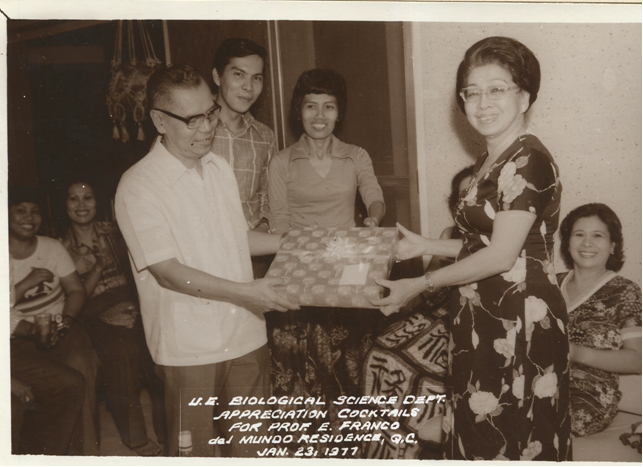
In Manila, we had a series of maids who served only awful food, compared to what the food in San Luis was. The only time we would have good food was during the birthdays of Dad and Mom. Those were memorable, because we would have three parties each time. The Gonzalezes had split into two groups, the group belonging to Lola Charing and the group of Tito Rogie, Dad’s best friend. So we always had two parties for the Gonzalezes. The third party was for the office mates of the celebrant. Mom was a teacher in UE and Dad was working in VLuna Hospital. Ate Tang was called to cook for these occasions, and she made sure that she cooked more than what we needed for the three parties, so we could continue to enjoy eating good food for the next few weeks. She always had chicken galantina, embotido, lengua, lumpia. During the Christmas season, it was customary to gift a good friend with an expensive Chinese Ham. Since Mom’s birthday was close to Christmas, one of the things waiting for Ati Tang would be the perennial Chinese ham. The Chinese ham was different from the “Virginia” ham, in that the Chinese ham was salty and dried. The Virginia ham was sweet and moist. Ati Tang had to soak the dry ham in water , boil it for a few hours and throw away the salty water and repeat this five or six times, until the ham started to become moist and sweet. In the final boil, she would throw in six bottles of beer and wine. I think she was not successful one Christmas, when the Chinese Ham was still salty after six tries!
Anyway, Ate Tang was synonymous with “good food.” Even my children’s ears perked up when they heard that Ate Tang was going to cook for a party that was going to be held at home.
2. Who am I in relation with Ate Tang
Normally, after the funeral mass, an immediate family member would go up to thank the congregation for coming to the Celebration of the Mass and to talk about the life of the Deceased. When I heard that Ate Tang had died, I immediately went to the house where Ate Tang had lived during the last few years of her life. Ate Tang never married, and I knew her parents had long gone. When I asked how these people in the house were related to Ate Tang, they just looked at each other, and shook their head. They were descendants of one parish priest Father Lozano who was assigned to San Luis. Ate Tang “adopted/took care” of their grandparents. Their parents were the children of these children, and the parents had either died, left for Manila or abroad. Then Ate Tang took care of them and their children. No one every asked them how they were related to Ate Tang. Like me, Ate Tang had been in their family for several generations, and she just stayed on with them. Ate Tang had sisters who had long passed away. These sisters had children, but the children lived somewhere else. Were Ate Tang’s nieces coming for the funeral? Nobody knew.
It was at this point, Cristan (my cousin) and I decided that we were as related to Ate Tang as anyone in the house where she died. I brought with me money which would be enough to pay for some expenses. Therefore, I plunked the money in the hands of one of the girls, Sarah, who had flown in from Davao after she found out that Ate Tang had died. Yes, Sarah was related to Lawang, who was somehow connected to Father Lozano . Cristan and I decided Ate Tang would be buried on Saturday, after the 3 p.m. Mass. We told Sarah and her relatives that we would scour for money from other relatives to make sure that all expenses that would give a memorable sendoff to Ate Tang, be paid.
Ate Tang’s name was Constancia Tuason. One of my ancestors was Eugenio Tuason. He was the parish priest during the time he brought forth my grandparents. He even had two wives, one Basilia Vicente, from which came the Franco branch, and another Maria Angeles, from which came the Elizalde branch. Yes, my father, Luis Franco, was the second cousin of my mother, Eglantine Elizalde Gonzalez, but their grandmothers were different. And while we are at the Family Tree, there is a High School in San Luis named “Augusto Gonzalez-Sioco High School.” Augusto Gonzalez-Sioco was the brother of my grandfather, Fernando Gonzalez (Sioco was their mother’s family name, and the Spanish always put the mother’s family name after the father’s family name. It could get confusing, sometimes.) But the High School did not belong to the Gonzalez family, but to the family of Cecilio Franco, the first cousin of my father.
So, since my great grandfather was a Tuason, it is highly possible that I was related to Ate Tang.
Why do I think that Ate Tang was related to me? She lived in the house where the Francos lived when she was growing up. When my father went to Manila to study, he lived with his half-brother, Aquilino “Kili” Sison. Kong[6] Kili was a policeman in Manila, and he lived in Tondo. Tondo was the largest settlement near Manila, for the working class. (The upper class lived in Malate, by Manila Bay). Ate Tang was there in Kong Kili’s house with Dad’s niece Swinda and his nephews: Gabeng, Floren, Lauren. Ate Tang went to a private girl’s school, La Consolacion College in Manila. This was why Ate Tang was very smart. She was schooled. I noticed during one of my parties that Ate Tang could hold a conversation in English with one of my American guests.
Ate Tang took care of Dely when she was a little girl. In Ninang Vi’s last years, she asked Ate Tang to share her room. Ate Tang was already debilitated by that time. Since Ninang Vi was staying on the second floor, one of my lasting memories of Ate Tang was of her sliding down the stairs, her bottom hitting every step, from the second floor down to the ground floor, to get something. This is why I had to make sure to leave my street shoes at the bottom of the stairs, so Ate Tang’s bottom would not get dirty.
3. LESSONS FROM ATE TANG’S LIFE
I have five children of my own, and none of them live in the Philippines. After I came from Ate Tang’s wake, I went into a panic. Is this the way I will meet my end, surrounded by people who are not related to me by blood? I was with Diana, and she told me of her mother’s spinster sister. The spinster decided to insure herself against loneliness and dying alone by adopting a boy. When the boy grew up, he sold all the property she gave him, and migrated. Diana’s mother asked her sister to move in with her. But the spinster didn’t want to change her surroundings. She let her driver and his family move in with her. So Diana had do make all the important decisions regarding her aunt’s life—to operate or not when the aunt had a fracture? and similar instances. The Aunt died surrounded by her driver and his family.
I thought, it is not enough to have blood relatives, to have someone to be with you in the last years of your life. One has to build relationships that one can depend on in the sunset years. We have to work on loving and being loved by people, who will want to come to our Final Mass, if not share our last years together. Ate Tang lived her life doing precisely that…
4. GOOD-BYE, ATE TANG
This was a fitting day to go back to The Creator. It is Ascension Day, the day when Christ finally went to Heaven and left his apostles and Mother. Ate Tang, thank you for all the things you did for each member of our family. Thank you for all the things you did for these people who are sitting in front of your casket, whom you have loved, and who love you.
Ate Tang, When you go to heaven, say hello to my Mom and Dad, my grandmas and my aunts, all your friends who have gone before you. You won’t need to cook for them anymore. Maybe they will cook for you, this time………..
________________________________________
[1] “Ate” pronounced “ah-the” strictly meant “older sister.” This had Chinese origins, since the second girl was called “di-che”, (di meaning second), then the third was “san-se” (san meaning three). It could be used for someone who was older than you, but not old enough to be your parents’ age.
[2] “Dang” comes from “inda”, meaning “mother”. It is a respectful term for a lady who is in the same age as your mother, but is not related to you. “Pemya” must have been taken from “Eufemia”.
[3] “Apung” is also the same as “Dang”, but can apply to males who are old enough to be your parents. “ildo” must have come from the name “Hermenigildo”, which was popular during those days.
[4] “Impo” means “grandmother”. “Impong Lori” was the mother of my Dad.
[5] “Bapa” means “uncle” You add an “ng” to Bapa to make it sound more fluid. Bapang Cecing the first cousin of my Dad.
[6] “Kong” is a term which is a short-cut to “Koya”, meaning “brother. You use it for people who are older than you, but not old enough to be your
 Elsietampong's Blog