Archive for the ‘Family Stories’ Category

SO THIS IS RETIREMENT

July 3, 2012

I look at my Husband. He is still good-looking. His face hasn’t gotten as many lines as mine. He still has a complete head of hair, except for some empty spots at the middle. He keeps his hair black. His brother has completely lost his hair, but not my Husband. He puts on a lot of hair-saving lotions, and drinks some pills that make the hair grow back. He still has a complete set of teeth. “Horse’s teeth,” I call them. I told him I married him for his teeth. I took a look at them, and decided, “Yes, this is the man for me.”

Finally, after more than forty years of being married, we finally have our own home. In our own names. All these years, we lived abroad, stayed in rented houses. Husband was a Diplomat, so we moved every four years. Bangkok, Nagoya, Kuala Lumpur, Nairobi, Seoul, Lesotho– these were all great postings. We lived in big houses because we had five children and a grand piano. If the living room was small, the piano needed to have its own room. Ah, that piano!

When our parents needed someone to be with them in the house, we decided to return to Manila to take care of them. We lived in the ancestral house. I took over my parents’ business, and the business fed us. We didn’t worry about the house expenses. It was great!

Then when both parents died, we had to divide the family business among us siblings. Things changed. My Siblings did not want to pay for the food that we were eating, the telephone bills, the utility bills. Husband had set up a house in one of my parents’ properties in Baguio, and Siblings wanted to sell the property on which the house was built. So he had to give up the house. The ancestral house in Manila was divided among us siblings. We were free to stay in the rooms that were assigned to us, but the house wasn’t ours. We woke up to the fact that we were now homeless!

Fortunately, we had saved a little money and were able to buy a lot that Husband liked. He built his dream house on this lot. This house was by the beach, but far from Manila. I looked at the Title of the property. It had both our names on it. Finally, our own home…….

The children had long since gone from our nest. After High School, they went to the United States to study. We never heard much from them, except if they had money problems. We visited them rarely, and they visited us rarely. They didn’t even invite us to their weddings. Except for one daughter. I told her that I would spend part of my inheritance for her wedding. She had a nice warm wedding where everyone attended. Our Token Wedding for the Children. We were not the close family type where we held each other close to our breasts. I raised them to think independently, and they live independent lives.

So now it is back to where we started. Him and me, alone. The only difference is that, before, it was just a tiny apartment. Now we have a beautiful new house. But because of the “beauiful house”, we have used up our savings. So we are now on a tight budget, just like before when we started.

I have staff who keep house for me, but they come from Manila, and this beach house drives them crazy. I can see in their faces that they want to take a break and be with people. I send them back to Manila for a few days. So there are days when I am alone and I have to cook and clean. I am thinking, maybe I don’t really need them any more.

It is back to Square One. Just Husband and Me. This is Retirement………..

———————————–

THE RETIREMENT HOME

You look around the house. There are no clocks. Why would you need clocks? There are no appointments to keep. There is no one waiting for you. You wake up when you wake up. You eat when you want to eat. You sleep when you are tired.

There are also no newspapers. This place is so secluded, there are no deliveries of either mail or newspapers here. The security is so tight, people carry IDs and are not allowed to walk around the area.

View from My Window

This is the view from my window during sunset. I don’t mind if the angels come directly from the clouds to pick me up from the balcony of my room– when the time comes to meet my Maker. As my Husband says, “I want to die here…”

KIDS AND ENTREPRENEURSHIP

March 1, 2012

KIDS AND ENTREPRENEURSHIP

My children always thought we were poor. I never gave them enough money. This fact was particularly obvious when we were in Kuala Lumpur, where their classmates were children of families whose father was in the oil rigs. The father would be away in the oil rig, making tons of money. The mother stayed behind in the city, often bored, so bored she would go into affairs with the houseboy or driver, and the children would be given all the extra money that was laying around in the house. So if the children were getting $30 a week, my children would be getting one-third of that. You couldn’t define poverty more than that!

When we were in Nagoya, we were really hard up. The UN rules stated that 25% of our salary should go to the home country. My husband was just divorced from his first wife. She left us with debts to pay for the very nice, but very expensive, things she bought for the house. That lasted almost twelve months into our marriage. To be fair, we were still using the curtains she bought, ten years later in our other posts. And with a big family, we needed to rent a large house that ate another 25% of his salary.

So, the children were given five clothes each, for the five days that they were in school. Then they had one special clothes for Sunday Church. Only the eldest, Robbie, got new clothes. He would hand down his clothes to his brother John and his sister, Gayle. There was always a ceremony during those days when he would give his clothes to John. Kwan, their nanny from Thailand would force John to say,

“Thank you, Robbie, for giving me your clothes.”

John would often rebel at saying this to Robbie. He would say to Kwan,

“But I don’t like to get his clothes. I want new ones for myself!”

Kwan would say gently, “But John, Robbie is so nice to you. He wants you to have his clothes. You should thank him for being so generous. Now say again after me, Thank you, Robbie, for giving me your clothes.”

Kwan would not give up until John would say these dreaded words. So, eventually, John would say them to Robbie, just to finish with whole ordeal and go play outside.

Eventually, the youngest girls got new clothes. After having two sets of children wear the same clothes, inevitably, the same clothes would be too worn down to be used again for the next set of children.

Anyway, you get the point. The children were poor, they felt poor.

ROBBIE

Since the children were in American schools, the PTA told us that the children should learn their keep at home. They should do chores for them to have pocket money. Robbie, at thirteen years old, worked as a Life Guard at the School. I remember that night at the school, watching a school play, when someone interrupted the show to ask if there was a doctor in the house. A child was found floating in the pool, and would someone help? I thought of Robbie, thank God, he wasn’t on duty when it happened. It was at 7 p.m., and he was off duty at 4 p.m. That’s how I remember that Robbie worked as a life guard, for his pocket money. He also washed peoples’ cars, but that didn’t last long because the families had houseboys and drivers who would do the job better.

GAYLE

Gayle called us one time at past eight o’clock. This was the same period that Robbie was working as a Life Guard.

“Mom, you’d better pick me up from —. I think I have dengue.” She was around eleven years old, and was working as a baby sitter.

“What?” I asked, surprised. “How do you know?”

“I had dengue while I was in the Philippines, and it is the same symptoms. Pick me up quick. I have told Mrs. ___, and they are coming home from their dinner date.”

It was no surprise to me that Gayle wound up as a medical doctor. Here she was, at eleven years old, giving herself a diagnosis for her symptoms.

Hubby and I picked her up, and we brought her to government hospitals. That was an eye opener, to see the state of government hospitals in Kuala Lumpur. The sick were sprawled in the emergency room, lying bloodied and unattended. I couldn’t take it. We called the private doctor, and we brought Gayle somewhere else, more decent.

That’s how I remembered that Gayle worked as a baby sitter after school when she was eleven years old. Gayle is two years younger than Robbie.

JOHN

John didn’t work for money until he was much older. Even during the time he worked for money, it wasn’t because he needed it. It was because he was not yet accepted into a university, and he was bored at home. So he decided to teach English. We were in Korea at that time. When John came home, I eagerly asked him,

“How was it?”

He quickly answered, “That was the longest HOUR of my life.!”

ABBIE AND JEAN

We had already paid ex-wife’s debts by the time the smallest two kids were grown up. The UN also had new salary rules that enabled us keep my husband’s salary in the country we were at. They also subsidized housing, which is always a big drain on any family’s budget. So, if Abby and Jean worked, it was because they wanted to have extra pocket money.

The two girls worked as Bus Monitors. This meant that they accompanied the school bus while the bus brought all the children home. They had to make sure the children behaved well in the bus, and they brought the children to their doors.

I didn’t think this was a big deal, until one time during a lull in our conversation, Jean broke the ice by saying,

“You think that we kids are such brats. Wait till you see the children these days. They are beyond your imagination.”

I asked Jean what made her say that, and she told me that it was difficult keeping peace inside a bus. That’s when I found out that her job as a Bus Monitor wasn’t as easy as one would think it was.

ENTREPRENEURSHIP

But entrepreneurship isn’t just “doing a job”. It is creating something out of a situation.

My first experience with entrepreneurship was when I was twelve years old. I was studying in an all-girl school, and I noticed that students wanted to give roses to their favorite teachers or to their “crushes”. “Crushes” were aimed at someone you admired greatly or to students who exhibited some male characteristics, and it was a temporary substitute for having crushes on a boy, until the real McCoy came around.

One of our distant relatives lived in a big mansion at the corner of our block. She had a garden full of roses. I decided to buy the roses and sell them to the girls in my school. Pretty soon, I was doing this regularly, and I was able to put away, what seemed to me at that time, a big stash of money. The gardener was surprised when he found out after several months, that I was doing this for money. He thought I was just buttering up my teachers.

ROBBIE AND HIS “TAXI”

When we were in Nairobi, Kenya, the children were all teenagers by then. I allowed them to go out to a nightclub with their friends during the weekends. They would use my car and go out together and come home together.

I noted that, every Friday afternoon, after the children came home from school, Robbie would get a lot of phone calls. The calls lasted a few seconds. He would give numbers, like “6:20”, then put down the phone. Another call would come in, and he would say another number, “6:10”. And so on and so on. This was puzzling to me.

I later found out, several months later when I noticed that my car depreciated very quickly and had the suspensions broken very fast, that Robbie was using my car as a taxi. The numbers he shouted into the phone during those numerous calls, were the times when he would pick them up. The report was that he would even have 12 teenagers into the car at one time.

By the time I found out, it was time to sell the car, and we were leaving the country already.

NEW TIMES FOR THE GRANDCHILDREN

The children have long since left the “nest”. With my frugal ways, they were able to study in good American universities. They now live their own lives and run successful careers. They don’t keep in touch with us often, because their lives are very busy. Sometimes, I see the new and expensive toys and clothes they are buying their children on Facebook, things they strongly wanted to have while they were growing up but never enjoyed while they were “poor” in my house. I wonder, if I gave them everything they wanted while they were growing up, would they have worked as hard to reach where they are now?

When my sister complains about her sons who don’t have the “killer” drive that she herself had in order to become successful in her new country, the USA, I tell her gently,

“That’s because your children’s parents were richer than your parents.”

Yes, “Necessity is the mother of invention,”……… as my mother always used to tell me.

MY TWO GRANDMOTHERS

September 12, 2011

Yesterday was Grandparents’ Day. I never met either of my Grandfathers. They were both dead by the time I was born. But I was lucky to have the love of my two Grandmothers, Impung Lori on my father’s side, and Mama Lola Tinang on my mother’s side. This blog is about them.

IMPUNG LORI

Impung Lori

Impung Lori was already 77 years old when I was born. She looked exactly like this picture as I remember her. She wore an embroidered cotton chemise under the thin blouse made of pineapple fiber. Then she had this billowy skirt where she had a pocket with a few coins to give to us urchins whenever we went to her room to ask money to buy some goodies for snacks. All my cousins knew I was her favorite, so I would be tasked to ask money from her. Many times she would be asleep in her bed. She hardly left her room, except for rare times when they would bring her out of the house to get some sun. It would take a lot of courage for me to rouse her from her sleep. But since our need for that snack was very great, I would summon all my nerve to nudge her and whisper to her to wake up. She never lost her temper at us for waking her up. If I asked for 5 centavos, she would pull out 15 centavos. How could 5 centavos feed around 5 of us kids, all under 6 years of age?

Impung Lori was the sister of two brothers who became Mayors of the small town where I grew up. She had another sister, Francisca. Mariano, her elder brother, was feared by many. He was known to have saved the centuries-old Church from being burned by the rebels who were fighting Spain. Her brother Felipe’s picture still hangs in the Municipal Hall to this day. He was an elected Mayor, not like his brother Mariano, who was just a leader. Felipe remained single until he died. From Felipe came a lot of the agricultural land that was distributed to his siblings and their children.

Lori married when she was 40 years old. When my father, the younger of her two children, was nine years old, Lori’s husband, Cenon, died. Lori herself died when I was in Grade 2. I will never forget the day when they distributed black veils to cover the women’s heads to allow them to grieve in private. I was given my own “manto” to cover myself. It made me feel so grown-up. The younger children were not given “mantos” like me.

I never saw Lori manage her rice and sugar lands. They were a few kilometers from town, along the main road. When my father was small, Lori would often go to her sugar mill to process the sugar harvest. From the list where all landowners were compelled to list their agricultural lands, Lori’s lands numbered around 200 hectares. These were surrendered to the Farmers who tilled them, in the name of Martial Law.

While I was growing up, I would often be sent to entertain Impung Lori. She would have spells of “nervios“, specially when my mother and father were having their quarrels early in their marriage. My mother would often run to Impung Lori to complain about my father. The object of their quarrels was mostly his playing mahjongg with his friends. Impung Lori would pretend to sympathize with her, but she was heard to say after my mother had left, “If I had the money, I would give my son some money to play.” Her two children were her most precious jewels.

She also suffered from nerves when my father was sent by the Philippine government to take further studies in Medicine. To distract her from her fears, I would regale her with stories of how well I was doing in school. That was an assignment that I took seriously. Fortunately, I was at the top of my class, at six years old! Even after Impung Lori was gone, I assumed that many old people needed to be entertained. So I tried as much as possible to visit them during my spare time. And to immortalize my love for Impung Lori, I named one daughter after her, and a whole building after her.

MAMA LOLA

Mama Lola

Mama Lola was 62 years old when I was born. She was different from Impung Lori. Mama Lola did things around the house. She cooked (none of her two daughters cooked!). She wove for me a small blue bag made from one-inch ribbons. This I brought to school as my school bag. Mama Lola died when she was 110 years old. But I never heard her raise her voice. She always kept her cool, in spite of the problems she had with her favorite son. Understandably, her son had gotten married, and had a growing family. So he wanted to have his share of the Estate of his father and his brother who died during the war from consumption. During those days, you never asked for your share of the Estate if one of your parents was still alive. But necessity drove my Uncle to go to Court to force his mother and his sisters to decide on the division of property.

Those were difficult years for me and the family. Everyone was stressed out. But you never heard anyone have what the young kids call now, “a blowup”. People talked in whispers. I heard Mama Lola curse, “sin verguenza!” under her breath. This meant, “without shame”. Mama Lola developed a life-threatening heart problem, so the Doctor recommended the sisters accede to the brother’s demands, for peace. Within two years, a settlement was reached. The brother, being the eldest son, received the best agricultural lands, the prized apartment in what was the best location in Manila, Malate. There was peace on the surface, but relations among the siblings were never the same. Then Martial Law took all the lands away from all the Landowners including the siblings, and it was everyone for himself.

I spent many decades with Mama Lola. In the afternoons, I would take a portion of her bed and fall asleep. Then she could not sleep anymore. She would pound on her pestle to make “nga nga” as I slept. This sound exists even in the mind of one of my daughters, Lori. Lori thought that the nga nga was the elixir of youth of Mama Lola, the reason why Mama Lola kept death at bay. Pound, pound, pound, she would go the whole day and night. After Mama Lola’s death, the smell of her nga nga pervaded the garden. She planted a vine there so she would never run out of the nga nga leaf. Mama Lola is still with me until this day.

I think of both my grandmothers on Grandparents Day, and wish them well in the other side of the world…….

Christmas in Baguio 2010

December 24, 2010

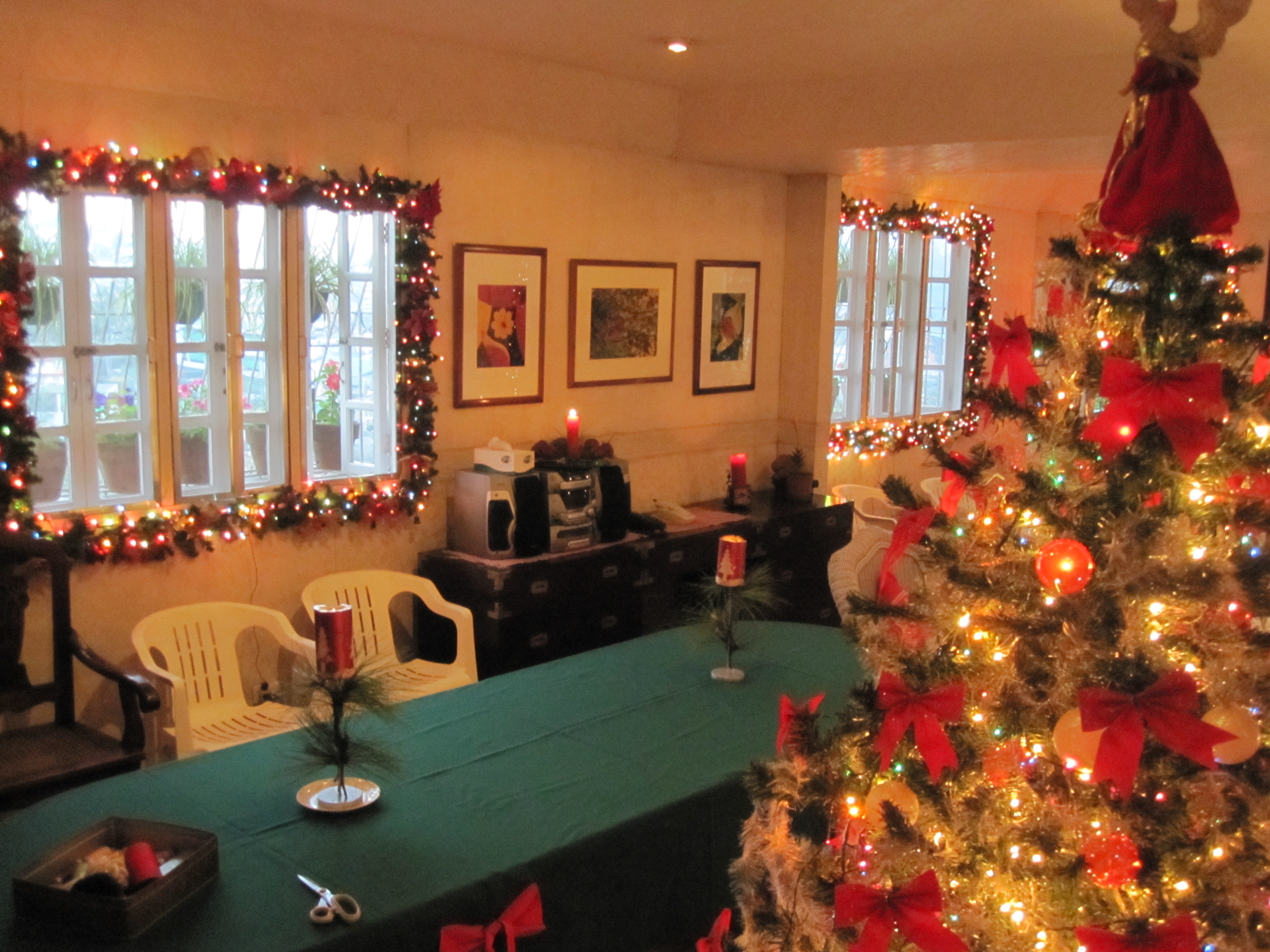
Baguio House on Christmas

Ralph and I don’t have children and family in the Philippines, so we give parties to Ralph’s brother, Jerry, in Baguio, to the Office Staff in Manila on Mom’s birthday, December 20th of every year, and to the Ralph’s cousins on both his parents’ sides, in the New Year.

Getting Jose to put up the decor

Most of the time, the house is also decorated by the Housekeeper/cook. This year, Ralph decided what she did wasn’t good enough. So he and Jerry took apart what Vilma did and jointly supervised the putting of the decor.

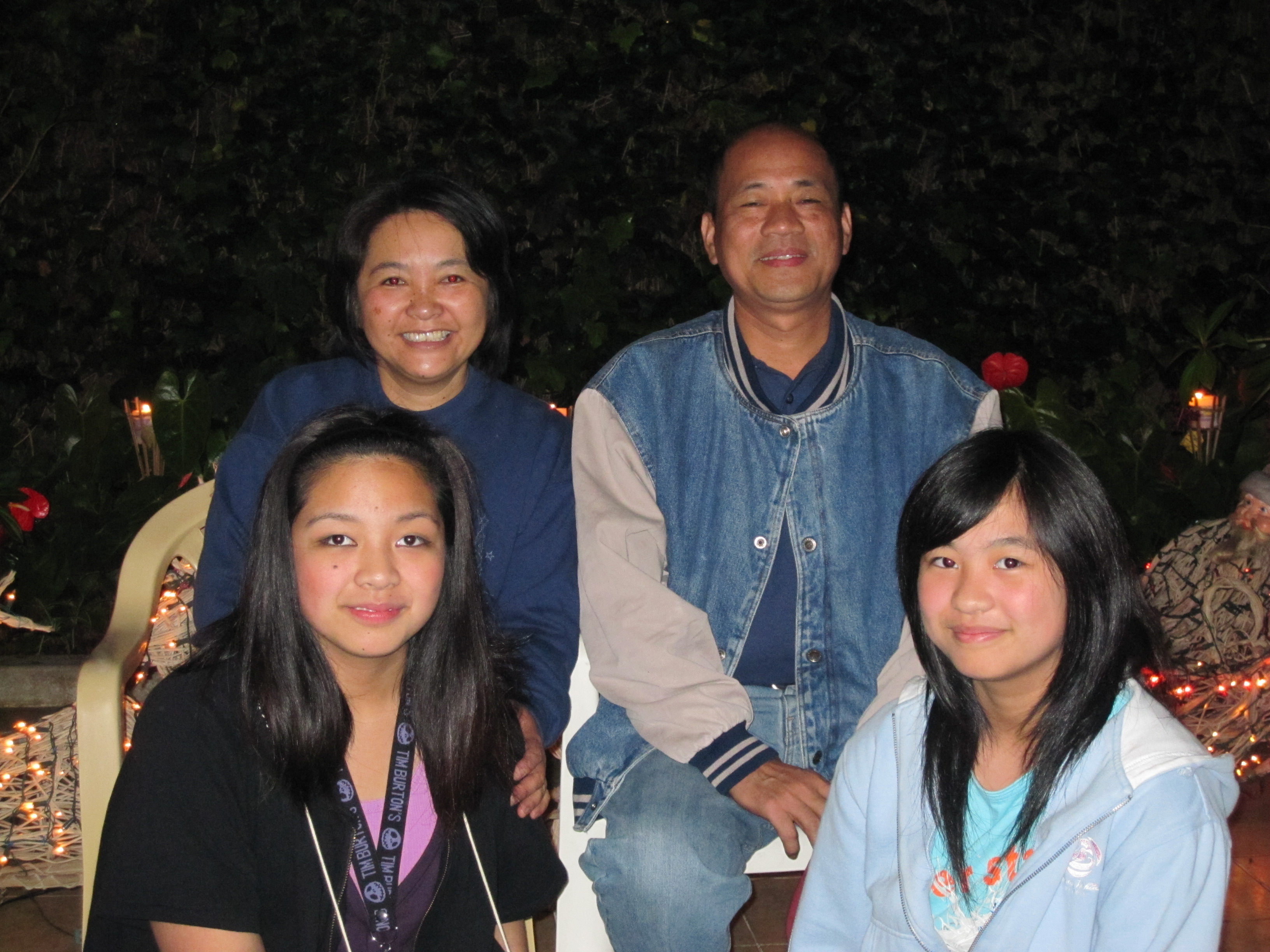
The family of Jerry has now grown. Raquel married an officer in the military, Jess . He turned 48 on the day of the party. They have two daughters. The eldest one, Sabrina, shocked me when she put in her facebook account, “I’m engaged!” I told this to Jerry, and he said he wasn’t aware that anyone was even courting her. She looked very quiet, and when I met her, there was no indication other than the make up on her face, that she would be seriously considering boys in the present.

Raquel's Family

Next daughter is Aprille. April’s husband is Anton, and they have two children, Anelle and Elvin.

Aprille's Family

Aprille works in the government and her husband Anton is an engineer. Anelle is so lady-like, and her younger brother Elvin is so cute! He makes me miss my own grandsons who are in Dublin and Denver, worlds apart from us.

Ralph and I with Celia's children

Celia is in China, and her husband John-john is working in a mine in the Visayas. So Ralph and I posed with Celia’s children, Trano and Diedre.

Trano gave me a song he composed that night,

This is gonna be a very blue Christmas
without you by my side
My past Christmas was all very white
But this Christmas, I’m not by your side.

I promise you this will never be repeated
You are the light of my Christmas tree
You are the Star that guided the three kings to Bethlehem
All I want is you (2x)

All I want is you this Christmas
You’re all I want
You’re the present that I only wish for
From Santa Claus who will come this midnight.

This year we have missed the Old Ones who have passed away — Ralph’s mother “Lola”, Lola’s sister Auntie Celing, Auntie Celing’s husband Doming, and Lola’s former housekeeper for sixty years, Sabel. Sabel’s son, Noel, who was adopted by Auntie Celing, also joins us every year in our Christmas parties. His children are such lovely children. I’m glad he raised them well.

This year, we have new staff in the house — Vilma Mayot (cook), and Tess, housekeeper. Jose, who has been with us for 12 years, was the one who helped in putting up the decor.

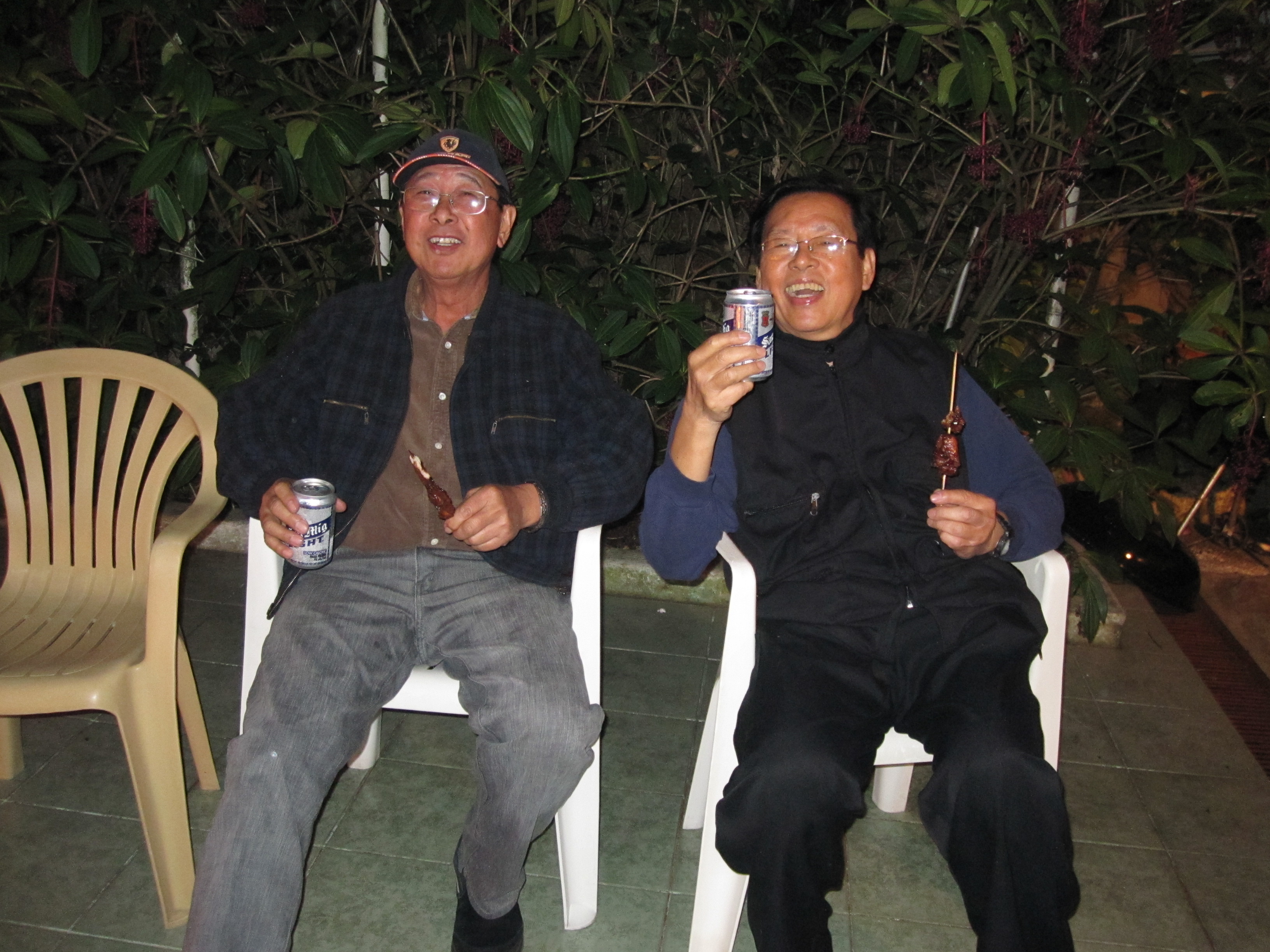
Ralph and Gerry sharing a drink and barbeque

Here are Ralph and Jerry, accompanying Jose do the barbeque at the back of the house, and sharing a joke.

Looking at Raquel and the whole group, I wonder, how did the time go so fast? I have images of Raquel and Reuven up in the guava tree, eating guavas as they went. Now Raquel might be a grandmother in a few years, if what her daughter said was right, that she was “engaged”.

THE WORLD ACCORDING TO LETY

July 12, 2010

This is a report of the conversations I had with Lety on May 22, 2010. I brought her to Baguio, because she had not been there for some time now. Lety was 6 years older than me. She was adopted by Impung Lori, the mother of Papa, Luis. They got her at birth from the Asilio de San Pablo, by the Pasig River. I don’t know why the adopted her. But I remember that when she went to High School, she went to St. Mary’s College in Quezon City. We shared the same room, but we had separate beds. Our room was on the ground floor. Lety was like a sister to me. Since she was older, I listened to her as she told me about life. Again, this time, I listened to her as we talked about the Good Old days.

IMPUNG LORI

Impung Lori loved Letty very much. Whatever Vi bought for her eldest daughter, Mel, Impo bought for Lety. Impo would feed Lety her food. Whenever she found that Lety was given a spanking by Luis, Impo would get sick. One time, for whatever strange reason, Lety needed to get a spanking by Luis. It was a big production. She was brought to the house of Apung Tinang. She was made to bend over a wooden bench. Then she was spanked with a stick. I watched Lety as she was spanked. She was kept in the house of Apung Tinang until there were no more traces of her tears and her sobbing.

Before Impung Lori died, she told Lety, “Remember, I told them to take care of you.” She also had a lot of her clothes remade for Lety, her nice clothes and even her chemises. She also had a black dress made for Lety. “I want to make sure that they allow you to wear black. They might not let your mourn properly with a proper black dress,” Impung Lori told Lety. Elsie didn’t get to wear a black dress. But they gave her a manto, a long black veil that was as long as a shawl, so she could hide her crying underneath the manto.

BAPANG ELY

When Bapang Ely came into the life of Ninang Vi, Ninang Vi was already past her prime. She had spurned a lot of suitors, one of them was a distinguished medical doctor. Was it because she felt it would be a betrayal if she got married to leave her mother? Anyway, when Ely came, men had stopped courting Vi.

“I want you to get married,” Impung Lori told Vi. “You will be lonely if you don’t have children.”

There was nothing outstanding about Ely. He had no job like that doctor who courted Vi. He didn’t hide the fact that he had a child out of wedlock. But he was a landowner, coming from a distinguished family in Arayat. When I once asked him what was his occupation, he answered, “A proprietor.” When I asked further what that word meant, he said, “Someone who owns property”.

Lety remembers that Ely used her to show Vi he would be a good father. He would cradle Lety in his arms, and show affection toward Lety.

Luis, Vi’s brother, asked his sister when she told him of her decision to marry Ely. “It doesn’t bother you that he has had a child by another woman?” She said no.

So the marriage took place in San Luis Church. It bore four children—Emelina, Edelwina, Raul and Cristan.

When Vi married Ely, the wife of Luis, Nena, took Letty when Vi and Ely went on their honeymoon.

Lety has many fond memories of Ely. She remembers that when the harvest was good, the farmers would celebrate with a big party as thanksgiving for the bountiful harvest. Vi and Letty would go to the rice fields and eat there with the farmers. Ely’s harvest was plentiful: his harvest was stacked in haystacks called mandalas lining both sides of the streets, from the Church all the way to the house of Noel, a distance of one kilometer.
Ely had a farm in Baleng Bayu in Sta. Maria. Lety remembers that he would get duck eggs and sacks of rice from this farm. Dang Baring, one of the merchants in San Luis, would exchange 5 salop of palay for 5 balots, or duck eggs. She would also trade half a cavan of palay for 1 plate of lechon. When Lety was with Ely, his farmers would give them 1 to 2 cavans of palay. And they would sell this for five pesos, (P5), a princely sum in those days. One cavan now costs P1,500 ($33) Cristan and Lety enjoyed harvest time. And always, they would give Dang Flor something. Anything that Vi had—food, harvest—she would always share with Dang Flor.

One of the memories I will never forget was Ely’s bringing home two dalags that were so long, they filled the whole basin. These came from Ely’s fishpond in Baleng Bayu. Yes, Ely had a fishpond there.

Ely was a very sociable person. He welcomed any visitor, even if all he could serve was a can of sardines. Ely was also a very good cook. He made everything taste very delicious, even the humblest of dishes.

But Ely was bored with the quiet life in San Luis. When the fiesta came, he and other young men (also married to the stiff upper class women in town who were inevitably related to each other) would line up to dance with the “taxi dancers”, as they called them. You bought a coupon and handed it to the girl with whom you wanted to dance with. The “cabarets” as they called them, were set up at the edge of town, behind the bamboo trees. The naughty young boys would watch through the thicket and report which husband was dancing in the makeshift “cabaret”.

Of course, Vi and Ely had their spats. He liked to occupy himself with mahjongg and card games with the boys. When Ely came home much too late, Vi would be angry already with him. Ely would go to Arayat, his home until Vi cooled down. Letty would pick up Ely when all was clear at the home front. This would take around three days.

COMMERCE IN SAN LUIS

A popular source of income of the women in San Luis was weaving mats. They would harvest leaves of the nipa plant. They would dry them overnight. In the morning, they would let the leaf go through a blade and cut it. Then they would weave the cut nipa into dase, or mats. The action of weaving was called “lala”.

At the back of Perry’s house( who lived next door to our house), several women would gather to weave mats. Apung Kare, the aunt of Ambo Diaz, Apung Pilang, a spinster, and Apung Eclang, would weave the whole week. Then on Tuesday, they would gather all their mats and bring it to Calumpit, the capital of Bulacan, the next-door province. The week of people was punctuated by “Market Days”—Sunday was market day in Arayat, Monday in San Luis, and Tuesday in Calumpit.

Lety would sell pichon, or doves at the Calumpit market. Until Land Reform took away the farmland of the Francos and Alejandrinos, there would always be pupul or harvest, of mango and corn, in addition to rice.

In the house of Clementina, one day a woman came with her daughter, seeking shelter. They lived in the ground floor of the house of Clementina. They were Dang Simang and Ati Maring. During the day, they would have all the women in their company weave mats. I don’t know the circumstances why Ati Maring was able to live in Mama Lola’s house. In those days, no one lived in the ground floor of the houses. People just lived on the top floors. They let their animals stay corralled under their house. The bamboo slats from the second floor went all the way down to the ground below. The animals stayed there, within the perimeters of the bamboo slats.

The house of Mama Lola was initially a “nipa house”, with nipa walls. My mother, Nena, when she saw it the first time said, “How can a Doctor Provincial live in just this nipa hut?” With this, she resolved her house would be better than her Father’s. This was the house that Dr. Fernando built for his retirement. There was a small balcony that jutted out in front. The wood of the balcony was made of wood, not of bamboo. Perry, the boy who lived next door, had bamboo slats. Between the bamboo slats, you could see the animals roaming below.

I don’t remember what the flooring of the ground floor of Mama Lola’s house was. What I remember it was that the ground floor a bit dark because the walls were made of stone or cement and didn’t let the sun come in, unless you had the main door open. And it couldn’t have had a flooring made of soil, because the women always sat on the ground while they were cutting their nipa and weaving their mats.

LIFE DURING THE TIMES OF THE HUKS

The Huks were people who were seeking social reforms. After the Spanish took away the lands, they gave it to local landlords who continued the Spanish system of large ownership of lands and getting the harvest from the ones who tilled in 70-30% shares. The Huks wanted to correct this. The leader of the Hukbalahap movement came from San Luis. He was Luis Taruc.

During the Huk movement, the people from across the river, those from Santa Monica, would evacuate to San Luis. One of those who lived in the Franco “Big House” was the sister of Luis Taruc. Elsie remembers her mother telling her,
“Don’t play with those children, they are children of the Huks.”
So Elsie went to them, saying, “My mother says I can’t play with you. You are children of the Huks”. Then proudly she returned to her mother, saying, ”It’s alright, Mom. I told them I couldn’t play with them because they were children of the Huks.”
Her Mom was aghast. She said, “You told them?”
And Elsie retorted, “Yes, I did.” I think that was the last time her mother ever told Elsie a secret that she wanted to keep as a secret.

Apung Tinang (Mama Lola)’s house was next to the Municipio, the Municipal Building of San Luis. When the police killed a Huk, they would wrap a mat around the dead body and display it in the Municipio. Sometimes, they would throw the Huk into the Pampanga River. When the police fish it, it is bloated and decomposing. They also bring this body to the Municipio.

So Elsie and Dodo always tried to see the bodies of the dead Huks from the balcony of their house.

Some of the people were related or were acquaintance of the Huks. The people with big houses had entre-suelos, which meant flooring under the floors. The bahay na bato (houses whose walls of their ground floor were made of adobe stone) had an elevated second floor, maybe fifteen meters above the ground floor. The ground floor would be where carriages could be parked inside the house. At one side, there was a sort of a mezzanine, the entre-suelos, that were about one meter from the ground. Normally, the entre-suelos had floors made of bamboo slats. Lety said that where there was a raid conducted by the police, the Huks would hide under the kawayan floor of the entre suelo. It was always so dark on the ground floor, you wouldn’t see anyone hiding under the bamboo slats of the entre-suelos.

MURDER AT MIDNIGHT

They say killings of people you don’t know are just statistics. But if it is someone close to you, then it is met with a lot of anguish and shock.

Bapang Piping and Luis were first cousins. Their parents, Lori and Kikang were sisters. Kikang was older than Lori. As such, she inherited the ancestral house of their family. Piping was the most high profile and most successful among his cousins. He worked for the government, the equivalence of the CIA, as – of course, as an informant. He had a service jeep at his command. This was a government issue jeepney, which could be used for his personal and official work.

One night, when Piping, his wife, his eldest daughter, and one neighbor who hitched a ride with them, were coming from the famed “Holiday On Ice”, an annual show held at the Araneta Coliseum in Quezon City, Manila, a good two-hour ride from San Luis,. When their jeepney hit the tallest part of the road, the dike that protected the neighboring towns from the water flooding the San Luis town, a slew of gunshots met this party. Piping was driving the open jeepney, and lost control of the vehicle. The jeepney fell into the lake below. The killers checked the bloodied bodies before disappearing into the night.

Piping’s daughter, Zeny, survived the ambush. She played dead when they looked at her. She waited for the killers to leave. When it appeared that it was all clear for her to go, she ran all the way from the lake to town. She first reached the house of the dentist Jesus. There, she became hysterical.

The brother of Piping, Bernie, was a medical doctor at a government hospital in Laguna, southern Luzon. He was very upset about this murder. The family had not yet finished mourning for the death of their father Apung Ato, and now another death.

Letty and Vi were in Vi’s lands in San Roque, a town across the river closer to Baliuag, when this incident happened. The whole town was in shock. Everyone felt pity for the daughter who survived the ambush. There were other children of Piping who didn’t go to the show. They were orphaned overnight.

The house where Piping lived was the ancestral home of their family. Their most distinguished family member was Felipe Carlos, who became the Mayor of San Luis. Felipe was single and died single. His older brother, Mariano, was considered a “tulisan”, a rebel. How could a tulisan be a brother to the Mayor? The cause of rebellion of Mariano was against the Spanish rule. The other rebels wanted to burn down the church of San Luis, and Mariano is credited to stopping them from doing so. In any case, Mariano lived two houses away from Kikang’s house. Lori had left the house to get married to Cenon. It was normal in Philippine society for the eldest child to inherit the ancestral home. So Kikang inherited the house, and handed it to Piping.

After the burial, the family of Piping left San Luis. His sister Salud took the children to her house in Cubao. Then they all moved to the United States. Eventually, the family of Elena Manankil bought the house from Zeny.

The rumor was that Peping was actually organizing the counterpart of the Huk Movement among the people of San Luis, the Monkeys. The Monkeys were organized to fight the Huks. After Peping died, the Monkeys came into existence. They killed the Huks in broad daylight, in the streets. Fear was sown in San Luis. Who was a Monkey? Who was your unknown enemy?

DANG MERENG AND BAPANG ANDO

Bapang Ando was a cousin of Luis. His wife, Mereng, was a dressmaker. When Mereng’s customers would try on the dresses that Mereng was sewing for them, Ando would peep at them. He was the town’s Peeping Tom. Their son, Milo, was born during the eclipse. This is why they say he was a bit sira ulo. Mereng and Ando lived for a very long time at the ancestral home of Ando’s father. After a while, they moved to a lot adjacent to the “Big House”. Maybe they didn’t have a lot of money to build their own house. But their daughter, Frida, became an Auditor of the Philippine government’s COA. Then she found a job at the United Nations and moved to New York. So she supported her parents until their death.

MEMORIES OF SAN LUIS

San Luis did not have electricity while Letty was growing up. There were just gasoline lamps that lit the house. Each person carried his or her own gas lamp as he went around the house.

The rich families had a gramophone with which to listen to music. There were plakas or black circular disks, on which the music was etched. The gramophone had a needle which read the disks and transmitted the reading to the sound box. Very few people would have the joy of listening to Mario Lanza with his tenor voice wafting through the air. But the air was so still in town, than you could easily share the sounds with the neighbors without having it full blast.

There were already movies when Lety was a little girl. They were showing in San Fernando, the capital of Pampanga. She needed to take a jeepney to go to San Fernando, a ride that took around 30 minutes, not including waiting time for the jeep to fill up. Letty’s best friend was Daisy, the daughter of Liling and Dr. Ibanez. When they went to San Fernando, they would stay there the whole day. They would also have a meal at the only restaurant in town, Everybody’s Café.

Every child is trained to go home before sunset. The Church bells ring at 6:00 p.m. for the Angelus. Every child scampers to his home as soon as the church bells start to peal. Woe to the child who is not home after the bells stop pealing. Usually that meant spanking at the buttocks. There were many sounds of church bells. There is a bell for a baby being born. There is a bell to announce death. There is a bell to announce Mass. Anyway, the bell is the center of life in town. It announces the time, the events, and the end of the day.

DODO

Dodo was a thin boy. He had a chest like a pigeon. He was prone to tuberculosis, and for a while, he did contract it. Letty said that, on days with full moon, when the moon lightens up the whole world, she and Dodo and all the other children, would play patintero. Patintero is a game where there are two groups that play against each other. The object is to go through the lines without being tagged. Those who go through the lines get a point. The ones with the most points are the winners.

written on June 2010

ATE TANG

May 30, 2010

Ati Tang

Ati Tang


ATE TANG

1. Who was Ate Tang?

Who really was Ate[1] Tang? One of my first memories was when I was around 4 years old, staring at a huge cauldron of bringhi. Ate Tang’s mother, Dang Pemya[2], was stirring the bringhi. The bringhi is like a paella, but it doesn’t have tomato sauce. It is yellow sticky rice cooked with turmeric and chicken broth, and some chicken pieces, like chicken liver. Dang Pemya was married to Apung Ildo[3]. Apung Ildo took care of roasting the lechons. Dang Pemya had been cooking for Dad’s mother, Impung[4] Lori. She was a big woman, like any self-respecting cook should look like. ( I never trust cooks who are skinny.) She had big breasts, and wore the baro’t saya, , the style of the 1880’s. That dress was used also by Impung Lori and her sisters-in-law (the spinsters Bentang, Dising and Juli) and Dang Floring, the sister of Bapang[5] Cecing, who owned the “Big House” of the Francos. My poor father, Luis, was the only thorn among the roses. He grew up the only boy surrounded by all these old ladies.

We would have two days of fiesta during those days—the bisperas (the day before the Fiesta) and the Fiesta itself. My other memory of the Fiesta was the Frog Vendor coming with skinned frogs, all four limbs stretched between bamboo sticks, and sold by the kilo.

My mother and father married and moved to Manila. Dang Pemya, Apung Ildo, Impung Lori and all the old ladies slowly died away. Only my grandmother, Clementina, lived on.

In Manila, we had a series of maids who served only awful food, compared to what the food in San Luis was. The only time we would have good food was during the birthdays of Dad and Mom. Those were memorable, because we would have three parties each time. The Gonzalezes had split into two groups, the group belonging to Lola Charing and the group of Tito Rogie, Dad’s best friend. So we always had two parties for the Gonzalezes. The third party was for the office mates of the celebrant. Mom was a teacher in UE and Dad was working in VLuna Hospital. Ate Tang was called to cook for these occasions, and she made sure that she cooked more than what we needed for the three parties, so we could continue to enjoy eating good food for the next few weeks. She always had chicken galantina, embotido, lengua, lumpia. During the Christmas season, it was customary to gift a good friend with an expensive Chinese Ham. Since Mom’s birthday was close to Christmas, one of the things waiting for Ati Tang would be the perennial Chinese ham. The Chinese ham was different from the “Virginia” ham, in that the Chinese ham was salty and dried. The Virginia ham was sweet and moist. Ati Tang had to soak the dry ham in water , boil it for a few hours and throw away the salty water and repeat this five or six times, until the ham started to become moist and sweet. In the final boil, she would throw in six bottles of beer and wine. I think she was not successful one Christmas, when the Chinese Ham was still salty after six tries!

Anyway, Ate Tang was synonymous with “good food.” Even my children’s ears perked up when they heard that Ate Tang was going to cook for a party that was going to be held at home.
2. Who am I in relation with Ate Tang

Normally, after the funeral mass, an immediate family member would go up to thank the congregation for coming to the Celebration of the Mass and to talk about the life of the Deceased. When I heard that Ate Tang had died, I immediately went to the house where Ate Tang had lived during the last few years of her life. Ate Tang never married, and I knew her parents had long gone. When I asked how these people in the house were related to Ate Tang, they just looked at each other, and shook their head. They were descendants of one parish priest Father Lozano who was assigned to San Luis. Ate Tang “adopted/took care” of their grandparents. Their parents were the children of these children, and the parents had either died, left for Manila or abroad. Then Ate Tang took care of them and their children. No one every asked them how they were related to Ate Tang. Like me, Ate Tang had been in their family for several generations, and she just stayed on with them. Ate Tang had sisters who had long passed away. These sisters had children, but the children lived somewhere else. Were Ate Tang’s nieces coming for the funeral? Nobody knew.

It was at this point, Cristan (my cousin) and I decided that we were as related to Ate Tang as anyone in the house where she died. I brought with me money which would be enough to pay for some expenses. Therefore, I plunked the money in the hands of one of the girls, Sarah, who had flown in from Davao after she found out that Ate Tang had died. Yes, Sarah was related to Lawang, who was somehow connected to Father Lozano . Cristan and I decided Ate Tang would be buried on Saturday, after the 3 p.m. Mass. We told Sarah and her relatives that we would scour for money from other relatives to make sure that all expenses that would give a memorable sendoff to Ate Tang, be paid.

Ate Tang’s name was Constancia Tuason. One of my ancestors was Eugenio Tuason. He was the parish priest during the time he brought forth my grandparents. He even had two wives, one Basilia Vicente, from which came the Franco branch, and another Maria Angeles, from which came the Elizalde branch. Yes, my father, Luis Franco, was the second cousin of my mother, Eglantine Elizalde Gonzalez, but their grandmothers were different. And while we are at the Family Tree, there is a High School in San Luis named “Augusto Gonzalez-Sioco High School.” Augusto Gonzalez-Sioco was the brother of my grandfather, Fernando Gonzalez (Sioco was their mother’s family name, and the Spanish always put the mother’s family name after the father’s family name. It could get confusing, sometimes.) But the High School did not belong to the Gonzalez family, but to the family of Cecilio Franco, the first cousin of my father.

So, since my great grandfather was a Tuason, it is highly possible that I was related to Ate Tang.

Why do I think that Ate Tang was related to me? She lived in the house where the Francos lived when she was growing up. When my father went to Manila to study, he lived with his half-brother, Aquilino “Kili” Sison. Kong[6] Kili was a policeman in Manila, and he lived in Tondo. Tondo was the largest settlement near Manila, for the working class. (The upper class lived in Malate, by Manila Bay). Ate Tang was there in Kong Kili’s house with Dad’s niece Swinda and his nephews: Gabeng, Floren, Lauren. Ate Tang went to a private girl’s school, La Consolacion College in Manila. This was why Ate Tang was very smart. She was schooled. I noticed during one of my parties that Ate Tang could hold a conversation in English with one of my American guests.

Ate Tang took care of Dely when she was a little girl. In Ninang Vi’s last years, she asked Ate Tang to share her room. Ate Tang was already debilitated by that time. Since Ninang Vi was staying on the second floor, one of my lasting memories of Ate Tang was of her sliding down the stairs, her bottom hitting every step, from the second floor down to the ground floor, to get something. This is why I had to make sure to leave my street shoes at the bottom of the stairs, so Ate Tang’s bottom would not get dirty.

3. LESSONS FROM ATE TANG’S LIFE

I have five children of my own, and none of them live in the Philippines. After I came from Ate Tang’s wake, I went into a panic. Is this the way I will meet my end, surrounded by people who are not related to me by blood? I was with Diana, and she told me of her mother’s spinster sister. The spinster decided to insure herself against loneliness and dying alone by adopting a boy. When the boy grew up, he sold all the property she gave him, and migrated. Diana’s mother asked her sister to move in with her. But the spinster didn’t want to change her surroundings. She let her driver and his family move in with her. So Diana had do make all the important decisions regarding her aunt’s life—to operate or not when the aunt had a fracture? and similar instances. The Aunt died surrounded by her driver and his family.

I thought, it is not enough to have blood relatives, to have someone to be with you in the last years of your life. One has to build relationships that one can depend on in the sunset years. We have to work on loving and being loved by people, who will want to come to our Final Mass, if not share our last years together. Ate Tang lived her life doing precisely that…

4. GOOD-BYE, ATE TANG

This was a fitting day to go back to The Creator. It is Ascension Day, the day when Christ finally went to Heaven and left his apostles and Mother. Ate Tang, thank you for all the things you did for each member of our family. Thank you for all the things you did for these people who are sitting in front of your casket, whom you have loved, and who love you.

Ate Tang, When you go to heaven, say hello to my Mom and Dad, my grandmas and my aunts, all your friends who have gone before you. You won’t need to cook for them anymore. Maybe they will cook for you, this time………..

________________________________________
[1] “Ate” pronounced “ah-the” strictly meant “older sister.” This had Chinese origins, since the second girl was called “di-che”, (di meaning second), then the third was “san-se” (san meaning three). It could be used for someone who was older than you, but not old enough to be your parents’ age.
[2] “Dang” comes from “inda”, meaning “mother”. It is a respectful term for a lady who is in the same age as your mother, but is not related to you. “Pemya” must have been taken from “Eufemia”.
[3] “Apung” is also the same as “Dang”, but can apply to males who are old enough to be your parents. “ildo” must have come from the name “Hermenigildo”, which was popular during those days.
[4] “Impo” means “grandmother”. “Impong Lori” was the mother of my Dad.
[5] “Bapa” means “uncle” You add an “ng” to Bapa to make it sound more fluid. Bapang Cecing the first cousin of my Dad.
[6] “Kong” is a term which is a short-cut to “Koya”, meaning “brother. You use it for people who are older than you, but not old enough to be your

ORGANIC BEAUTY SECRETS OF MY HUSBAND

May 28, 2010

Husband is attending a Seminar on Organic Agriculture this week. He is all of a sudden interested in “The Lead in Lipsticks.”

“Did you know there is lead in lipsticks?” he looks up from the newspaper article he is currently reading.

“Yeah, I knew that a long time ago.” sort of “ho-hum” type of answer.

“It says here that gloss has less lead than the pigmented opaque lipsticks.”

“Oh, Lord, I can’t bear this anymore,” I tell myself. Loudly, I say,
“Gloss is just made up of jelly substances, like petroleum jelly. Why should that have lead?”

“I hope that petroleum jelly does not have lead. That is what I use for my lips,” his eyes sparkle.

“Yes, I should write an article of all the unconventional organic beauty products that you use,” I taunt him. I will ask my cousin Tweetums to put them in her column. That will make interesting reading. Then I enumerate all of them.

Husband says, “If you write about me using Organic beauty products, they will say I am a “bading”(effeminate).”

“No,” I counter, “for a very long time now, men have started to use more beauty products than our parents have done before during their lives. You don’t have to be a bading to use beauty products.”

Husband is not a vain person. But he likes to look good. I remember that when I told my girlfriend that I was marrying Husband, she looked at me and asked, “The guy with the nice Italian shoes?”

“What?” I almost shouted, “You mean to say that you actually look at the shoes a Guy is wearing when you talk to him?”

That was my first hint about his tastes. Husband likes a few but expensive things. I didn’t even notice that he wore nice shoes. What I remember filing in my head about him was that he had a mouth full of perfect natural teeth. They were not movie-star even, but they looked like good, sturdy teeth. The kind one would look for when one was buying a horse.

After I married Husband, I saw that he had his name embroidered inside his coat pockets. We lived in Japan at that time, and he had a suitcase full of nicely tailored suits. And in each of them, the inside of the coat pockets bore his name.

When I was pointed this out to my new maid, who used to work for the Elizaldes, owner of the softdrink company in Manila, she told me, “Yeah, Sir (Husband) has nice suits. But, M’am, they are already old style.”

When she noticed that I seemed upset with this new revelation, she tried to make me feel better by saying, “But, M’am, don’t worry. His style is coming back in fashion. Some of the new suits in the magazines are similar to his style.”

I don’t know if this made me feel better: His clothes are so old, they are now almost back in fashion again. Well!

Okay, what are the things Husband uses that other Men could learn from him? Well, first, Husband’s hair has been thinning for the last twenty years. His only brother has had a bald pate for the last ten years. His younger brother, at that! How does Husband hold on to the last few threads of hair? He uses Gugo (bark of the tree) shampoo every night. Then he splashes and massages Dr. Vinzons Pineda’s Regroe Lotion onto his head. He read somewhere that, one of the side effects of the anti-prostate cancer medicine, Proscar, is to grow hair. So he pops a pill of Proscar into his mouth.

I found out that Husband’s secret to keeping his good teeth was to spend one minute brushing each tooth. Well, actually the gum dentist from South Africa said one should put the edge of the toothbrush bristles inside the pocket of the gum holding the tooth. Then one should brush outwards to take out the plaque that is hiding there. Husband does exactly that. Woe to you if you need to use the bathroom, and he is doing his one-minute-a-tooth exercise. Grrr!

I am 6 years younger than Husband, but if you look at him, he has no eye bags. His secret? He puts a streak of toothpaste on his eye bags. He sleeps with this toothpaste-on-the-eye bag make up. In the middle of the night, this brushed toothpaste almost gleams in the dark. If you were not expecting the white glow, you will think a special ghost is sharing your room with you. I don’t know the brand of toothpaste that he uses, but it is an imported brand. Husband says it kinda stings when you put the toothpaste on your sensitive skin. But you get used to it. I works, too! And it is cheaper and less painful than having surgical removal of the eye bags.

Well, I just have to write this article. When I don’t put them down, other articles come to my mind, and the unwritten articles remain unwritten and in time, forgotten.

Happy Organic week to you all!

MOM: The Professional

May 4, 2010

Retirement

Mom garnered three degrees under her belt, just waiting for Dad to finish his Medical degree. She wanted to take up Medicine, just to be near him. But her Father, Lolo Papa, told her “It’s a waste of time, energy, and money”. I wonder what he finally said (to himself) after she spent all those years in college. She might as well have become a doctor. She finished two Bachelor’s degrees — in Science and Pharmacy, and a Master in Science degree in Botany.

I know that Lolo Papa complained about her expenses. She lived in a Dorm. Mom said that one time, Lolo Papa commented on her purchase of shoes. She never forgot about this incident, since she still recalled it to me 25 years after the fact. I also saw a letter written by Lolo Papa to her Dorm, allowing Dad to visit her. Apparently, the Dorm was getting worried about his frequent visits to her, and formally asked Lolo Papa whether he allowed it. The tone of Lolo Papa’s letter was a bit whimsical, even philosophical. I don’t have the letter right now in my hands, but he said that if that was her wish (to see Dad all the time), he would trust her decision. It was obvious that to be with Dad was at the center of her existence at this point.

Mom had a rough time all her life. This included the time when she was a Professor of Botany in a downtown University in Manila.

Before Dad was assigned back to Manila, Mom used to commute by bus. (Nowadays, “commute”, is a noun to signify taking a public vehicle.) It was a 10-minute walk to the bus stop in Kamuning, then she would take the bus to the University Belt. The neighbors would always say as she passed by, going click-click-click with her 3 inch high heeled shoes, “There goes Mrs. Franco on her way to school.”

It was hard for Mom to combine running the home with three children and her career at the same time. She was never lucky with maids. Then by the late 1950’s, she started buying property and building on them.

When I turned 18 years old, Dad was already back in Manila. Dad had gotten the hung of the business. He borrowed $67,500 from the bank, and bought Mom a Mercedes Benz. He also used part of the money to construct on one 900 sq.m. lot they bought on the way to the airport, and to renovate the old house where we still live in.

The Mercedes Benz was probably why Mom’s co-teachers didn’t like her. She didn’t “belong”. She also went to a beauty parlor every week (I went with her) to have her hair done. She bought this 3-carat diamond ring from Hongkong and wore it everyday to school. The only co-teacher who stood out like Mom was Mrs. Anson, the wife of movie star Oscar Moreno. She was mestiza and good-looking, but I doubt if she had a Mercedes Benz and a 3-carat diamond ring every day to work.

This Downtown University was a commercial school. Mom taught in classes the whole day. She came home with loads and loads of laboratory papers and test papers. A few years before she retired, she hired someone to check the papers.

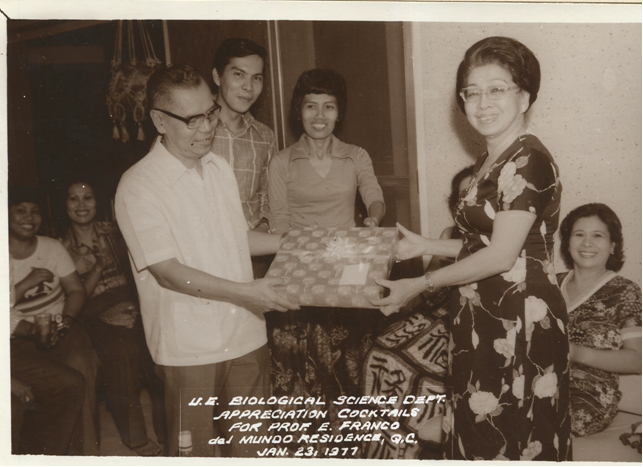
I saw her letter to the University asking them to allow her to retire before the mandatory age of 65. She was 64 years old, and had written a Manual on Botany for the beginners. She expressed hesitancy in retiring, but it was something that she had to do for her personal life. Now that I look back, I wonder:– did she find out about Dad’s infidelities? I know that Dad retired at the same time, 1977, after he suffered a stroke. Did he leave for North America during this time, and she felt she should join him?

I never got to ask her that question. I never asked her personal questions.

Mom: The Early Years

May 2, 2010

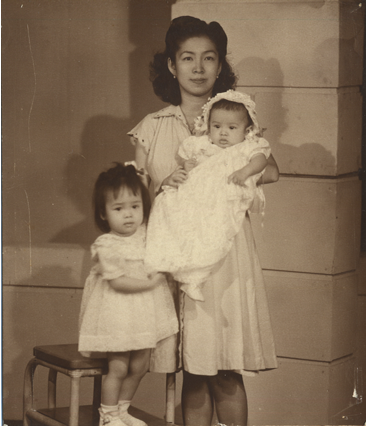
Mom with Dodo and me 1948

Mom always thought I loved Dad and not her. A few days before she died, she tried to tell me that Dad was not perfect. How she had been hurt by him all these years, not physical abuse, but by her perceived infidelities made by him.

I have a lot of pictures of Mom. When she was in her twenties and throughly in love with Dad. As a little girl consumed by her insecurity of being the “ugly and stupid duckling” of her family. Of her finding professional maturity, writing her Manual for Botany. And her last years as an old woman. I could write a book about her, really, but I just have to write this blog before I go off to check on one of my buildings.

I chose this picture of our family. Mom, Dodo and me just before she went off to join Dad in the USA. She must have had this picture taken to send to him. He must have written one of those mushy love letters he always wrote to her, telling her how much he missed her, and the little ones. This was when Dad went to Johns Hopkins University to take his Master of Public Health degree.

I also have letters written during these times. Mom said that I was starting to feel insecure. She was running an ice drop business with my Ninang Micay (remember Elsie Tampong era?). It was located in Vigan (Ilocos Sur), and Mom had to go with Ninang Micay to check on the profits. She would leave me and Dodo with her mother and sister Ninang Nancy in Pampanga. Dodo was too young to feel the pangs of separation. Besides, he was doted upon by Ninang Nancy. Ninang Nancy had a group of spinsters who were always with her in her (religious) activities, and they found a toy in Dodo. He was always in the midst of them. Their cute Baby.

When Mom got ready to join Dad in Maryland, she wrote him, “I am hesitant to leave Elsie again. Every time I came back from Vigan, I would find her with tears in her eyes. I don’t know how she would feel if I were to go again, this time, for a longer period. She clings to my dress every time I go out, thinking I am going away and not coming back.” Of course, anyone who has had a child, know that when the child is around three years old, it is difficult to leave the house without the child having separation anxiety. But these were in Mom’s letters to my Dad.

I don’t know when my affections shifted to my Dad. But it was not true that I didn’t love my Mom. She was my sole pillar when I was growing up, when Dad was always away.

A few days before Dad died, he made me promise that I would love my Mom and that I would take care of her. It wasn’t necessary for him to have asked that of me, because I was doing both. But maybe, he, like Mom, thought I didn’t love my Mom enough, and he wanted to make sure that I would take care of her after he was gone.

Spring!

April 10, 2010

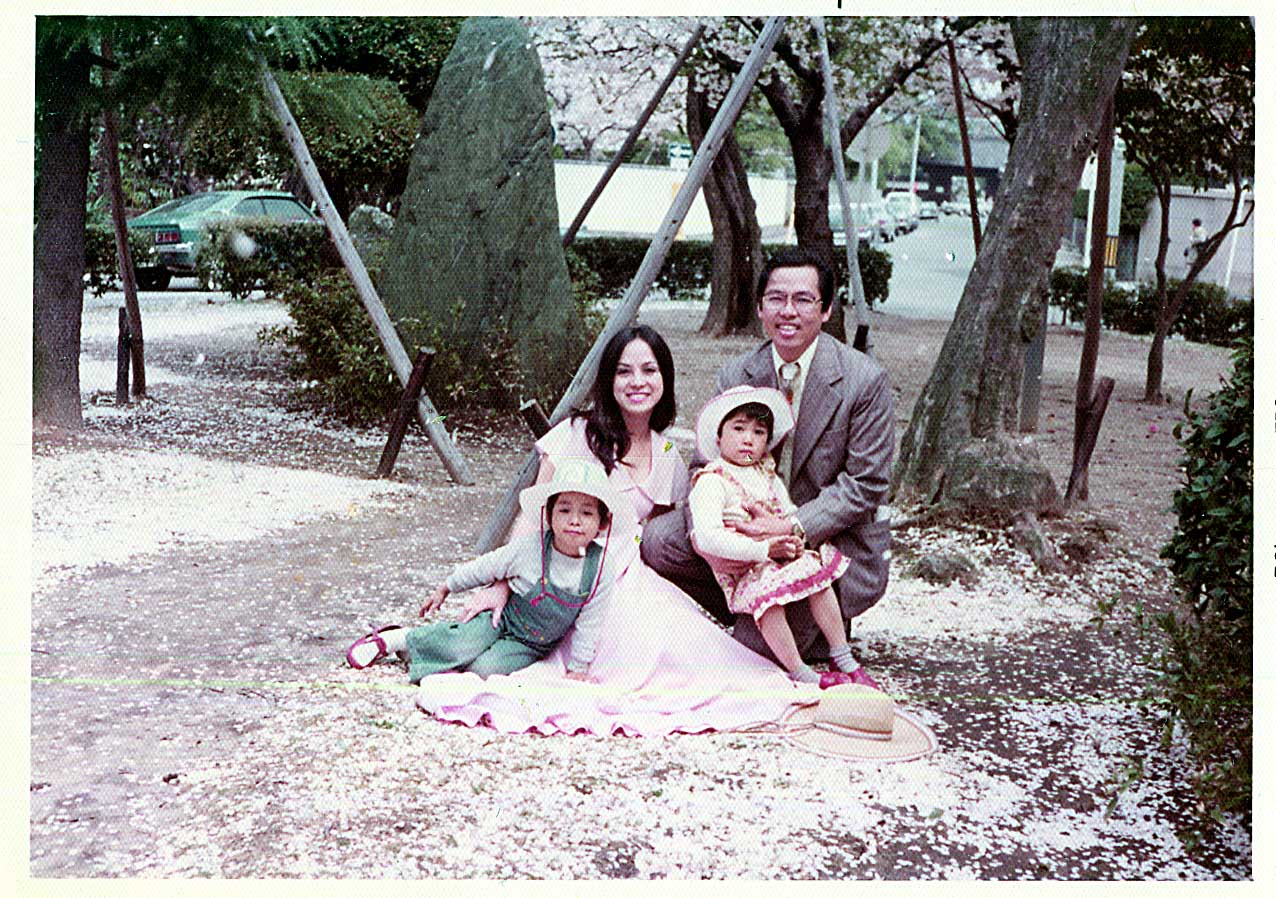
Sitting under the Cherry Blossom Trees with the Twins

Cherry blossom time was always special for me. Coming from the tropics, it was almost a miracle for me to see the trees turn all pink. I loved the hanami where everyone went to the parks after work with their barbecue pits and sake, and sang under the cherry blossom trees. The lights in the parks even gave the pink blossomed trees an ethereal feeling. I could never get over this. It was a feeling that I never felt before.

When we moved to Japan, I just knew I had to capture this moment. The three elder children had gone to school, leaving the twins, Lori and Elena, at home. Then Ralph came home for lunch. Perfect! I donned my pink gown that I had used for Cynthia’s wedding, and Ralph put his tripod in front of the tree where the cherry blossoms had fallen. We sat on the ground, and voila!– we had this picture.

Even years after the novelty of seeing the flowers and leaves change during the four seasons wore off, I still got thrilled at the sight of the cherry blossoms. I have to admit that, until now, I still can’t distinguish the cherry blossoms from the plum blossoms. I know the latter are more deep in color.

When we were posted in Korea, I got excited over the sight of cherry blossoms again. In our last year in Korea, when I felt that our days in that City were numbered, I asked Ralph whether we could go to Kyong Buk Palace to take pictures of the cherry blossoms. We chanced on a wedding party where the bride sat under the cherry blossom trees. She wore her white bridal gown, and she was so beautiful in that shot. I should try to locate that picture. It was so special.

We are now back in the tropics, and I miss seeing the cherry blossoms again.